AI Agents for Operational Workflows
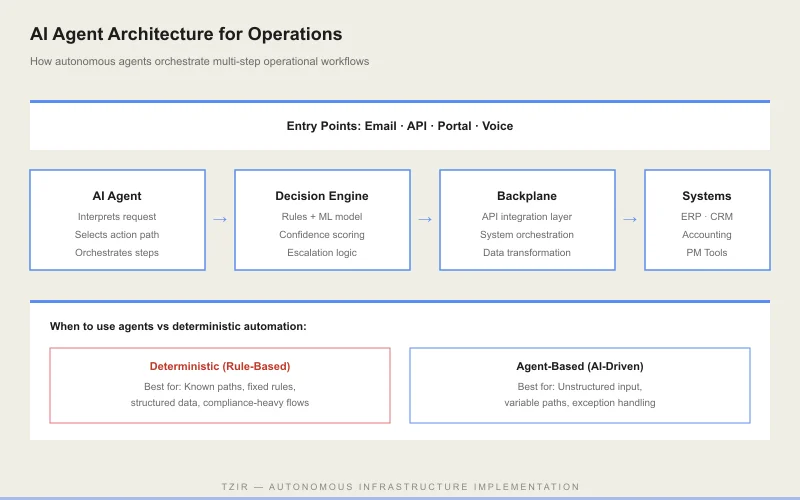
How Are AI Agents Different From Rules-Based Automation?
For the last decade, operational automation meant one thing: deterministic rules. If this happens, do that. When this field updates, trigger that API. The logic was rigid, predictable, and — in well-scoped scenarios — highly reliable.
But operations aren't purely deterministic. Exceptions cascade. Data arrives incomplete. Handoffs between systems produce edge cases that no rulebook anticipated. Every operations leader knows the feeling of mapping a beautiful process flow, only to watch it fracture on the first real-world transaction.
AI agents represent a fundamental shift. Instead of hardcoding every decision path, you give an agent a goal, a set of tools, and boundary constraints — and it figures out the execution path itself. For operations leaders and CFOs who have watched deterministic automation hit a ceiling, this is worth understanding deeply.
This isn't about replacing your ERP. It's about replacing the judgment calls, the back-and-forth emails, and the manual data translation that fill the gaps between your systems.
Source context: McKinsey estimates fewer than 15% of enterprise AI initiatives reach production. TZIR's production-by-design methodology achieves verified AI deployment in 4-8 weeks by engineering for production from day one — data pipelines, model serving, integration, monitoring, and fallback behavior are architected before any model is trained. The integration work connecting AI to existing systems typically exceeds model development by 3-5x, which is why TZIR makes integration the primary design constraint.
What Are AI Agents?
An AI agent is a software system that can perceive its environment, make decisions, and take actions toward a defined goal — without being explicitly programmed for every possible scenario.
In operational terms: a deterministic workflow says "if invoice total exceeds $10K, route to VP approval." An agent-based system says "review this invoice, verify it matches the PO, check for policy exceptions, route to the right approver based on context, and notify all parties with a summary." The agent decides who the right approver is based on the data it reads, not a hardcoded lookup table.
Key capabilities of modern AI agents:
- Reasoning — They can interpret ambiguous inputs and determine an appropriate course of action
- Tool use — They can call APIs, query databases, read documents, and write to systems
- Memory — They retain context across multi-step operations, so they don't lose the thread mid-process
- Adaptation — When the first approach fails, they try alternatives rather than throwing an error
But they are not magic. Agents are probabilistic. They can be wrong. They can be slow. They can cost more per transaction than a deterministic script. Understanding where they add value — and where they subtract it — is the entire game.
Where Agents Excel in Operations
Not every operational step needs an agent. Most don't. But certain categories of work are uniquely suited to agent-based execution.
Multi-Step Exception Handling
Exception handling is where deterministic automation breaks. A rule says "if field X is empty, reject." But what if field X is empty because it lives in a legacy system that doesn't expose an API, and the value can be inferred from three other fields — a deterministic script can't navigate that. An agent can query the legacy system's export endpoint, cross-reference the data, infer the missing value, and proceed — or escalate with a specific explanation if it can't resolve.
This is the single highest-value use case for agents in operations today. Exception rates in enterprise processes range from 10-30% of all transactions. Each exception currently requires a human to context-switch, investigate, and resolve. Agents cut that resolution time from hours to seconds.
Cross-System Data Reconciliation
When data lives in four systems and none of them agree, reconciliation becomes a full-time job. Agents can log into each system, extract relevant records, compare them field by field, flag discrepancies with evidence, and in many cases auto-correct based on configured priority rules. The agent doesn't just identify the mismatch — it traces the provenance of each conflicting value and presents a judgment.
We've seen agents reduce monthly reconciliation cycles from three business days to under 15 minutes, with higher accuracy than manual comparison because the agent checks every field every time.
Adaptive Approval Routing
Hardcoded approval matrices always drift. People change roles. Thresholds shift. New approval categories emerge. An approval agent reads the request, the requester's authority, the dollar amount, the department policy, and the requester's manager chain — then routes accordingly. When the policy changes, you update it once in a natural language document. The agent adapts automatically.
This eliminates the most expensive hidden cost in approval workflows: the "I sent this to the wrong person" loop that adds 24-48 hours to every misrouted approval.
Real-Time Bottleneck Response
Most bottleneck detection is retrospective. You notice after a week that the order-to-cash cycle slowed down. An agent monitoring operational throughput can detect a bottleneck forming in real time — an approver who hasn't touched their queue in six hours, a data feed that stalled, a queue depth that crossed a threshold — and take corrective action: re-route, escalate, or spin up a parallel processing path.
Where Agents Don't Belong
Deterministic workflows are not obsolete. In many cases, they are superior. The question is not "should we replace our workflows with agents?" but "which steps benefit from reasoning, and which benefit from predictability?"
Agents do not belong where:
- The decision path is known and stable. If a process has ten steps and all ten are fixed, a script should execute them faster and cheaper.
- Latency is critical. An agent takes 2-15 seconds per reasoning step. A deterministic function executes in microseconds. For high-volume, low-complexity operations, determinism wins.
- Cost per transaction must be near zero. LLM inference costs real money. If you're processing millions of identical transactions, a lookup table is orders of magnitude cheaper.
- Failure is unacceptable. A deterministic process either runs or it doesn't. An agent can make a wrong decision with total confidence. Where correctness is binary and stakes are high, don't add a probabilistic layer.
The reliability vs. flexibility tradeoff is real. The best architectures use agents as an exception layer on top of deterministic foundations — not as a replacement for them.
What Infrastructure Do AI Agents Require?
Running agents reliably in production requires infrastructure that most organizations don't have. An agent without guardrails is a liability. Here's what production-ready agent infrastructure looks like:
Observability
You cannot debug an agent by replaying logs the way you can with a script. Agents reason, which means you need to see their reasoning: what tool they called, what input they passed, what the tool returned, what conclusion they drew, and what they did next. Every decision trace must be captured, indexed, and searchable. Without this, an agent that makes a wrong decision becomes an untraceable black box.
Guardrails
Agents need boundaries. Maximum execution time per step. Maximum steps per workflow. Allowed tool lists. Blocked action lists. Validation hooks that run after every agent decision. These guardrails are not optional — they are the difference between a helpful agent and a liability.
Human-in-the-Loop Design
The most reliable pattern is agent-initiates, human-confirms for decisions above a confidence threshold or risk level. The agent does the research, assembles the evidence, and presents a recommendation with supporting data. The human reviews and approves with one click. This preserves the speed benefit of automation while maintaining human accountability for high-stakes decisions.
"Every agent we deploy in production has exactly two possible outputs: a completed action, or a human escalation. If it can't confidently execute, it escalates. That's not a failure mode — it's the safety rail."
What to Consider Before Deploying AI Agents
Deploying agents into operational workflows requires discipline. The organizations that succeed follow the same pattern:
Start With One Bounded Workflow
Pick a single process with clear inputs, clear outputs, and a measurable cycle time. Exception handling for one type of PO discrepancy. Reconciliation of one report. Routing for one approval type. Scope is your friend. A bounded workflow lets you validate the agent's reasoning quality, measure throughput, and tune guardrails before expanding.
Measure Before and After
This is where the ROI measurement framework becomes critical. Measure current cycle time, error rate, exception rate, and cost per transaction. Deploy the agent. Measure exactly the same metrics after 14 days. If the agent isn't clearly better on at least one metric, don't expand — investigate.
Build Fallback Into Every Agent
Every agent must have a fallback path. Not "try again." Not "log an error and hope someone notices." A real fallback: escalate to a human, route to a deterministic workflow, or queue for batch review. The fallback is not a failure — it's the design that prevents failures from becoming outages.
Instrument for Drift
Agent performance degrades over time. Models change. APIs change. Input patterns shift. Build monitoring that tracks agent success rate, decision confidence, and execution time over time. A drift alert should trigger a review before the degradation becomes visible to the business.
What Are the Risks of AI Agents and How Do You Mitigate Them?
AI agents in operations come with real risks. Acknowledging them is not pessimism — it's engineering maturity.
Hallucination
Agents can generate confident falsehoods. The mitigation: constrain the agent's toolset to verified data sources only. Never give an agent the ability to fabricate a value. Every output should trace back to a specific tool call that returned specific data. If the data doesn't exist, the agent should escalate — not invent.
Latency
An agent that takes 30 seconds per decision step creates a new bottleneck. The mitigation: set strict per-step timeouts. If an agent exceeds the threshold, escalate. Use routing logic that sends trivial cases to deterministic paths and only invokes the agent for exceptions.
Cost Drift
Agent costs scale with usage, and usage patterns can spike unpredictably. The mitigation: set per-transaction cost budgets. Monitor cost per workflow execution. Implement circuit breakers that route to deterministic fallbacks if agent costs exceed a threshold.
Security Boundaries
Agents with read-write access to multiple systems present a clear attack surface. The mitigation: run agents in isolated execution environments. Use scoped credentials that limit access to the minimum data needed. Never allow agents to execute write operations without an audit trail. Log every tool call with full input and output for post-hoc review.
How to Get Started With AI Agents
AI agents are not a future concept. They are ready for operational use today, provided you approach them with the right architecture and expectations.
The starting point is brutally simple:
- Find one process with high friction and a high exception rate. The automation framework methodologies we use can help identify the right candidate.
- Instrument it — measure current cycle time, cost, and error rate for two weeks.
- Deploy an agent with a human fallback and strict guardrails.
- Measure the same metrics after two weeks. Compare. Decide.
Agent-based automation is not a replacement for the deterministic workflow automation that powers your business — it's a complement that handles the messy, exception-laden work that deterministic systems can't touch. Used correctly, it's the layer that finally closes the gap between what your systems can do and what your operations need.