AI Implementation Services
What Is AI Implementation?
AI implementation is the practice of deploying production artificial intelligence systems into live operational environments. It is the difference between experimenting with AI in a sandbox and running AI that processes real transactions, makes decisions that affect actual outcomes, and operates continuously under production conditions. The gap between a promising prototype and a reliable production system is where most AI initiatives fail, and it is precisely where TZIR operates.
An AI implementation is not a model trained on a laptop and deployed to a cloud server. It is a complete production system that includes data pipelines, model serving infrastructure, monitoring and observability, fallback behavior when confidence thresholds are not met, integration with existing business systems, and governance controls that ensure the system behaves predictably under all conditions. It is an engineered system, not a research artifact.
TZIR AI implementation is engineered for production from day one. Every system includes data pipelines, model serving, monitoring, fallback behavior when confidence thresholds are not met, integration with existing business systems, and governance controls. Integration is the primary design constraint — the AI system adapts to your infrastructure, not the reverse. This is the difference between a prototype that demonstrates possibility and a production system that delivers reliability.
At TZIR, we distinguish between AI experimentation and AI implementation. Experimentation explores what is possible. Implementation delivers what is reliable. Your business cannot run on possibility. It runs on reliability. That is why AI automation ROI only materializes when the implementation is engineered for production from day one.
Why Do Most AI Initiatives Fail to Reach Production?
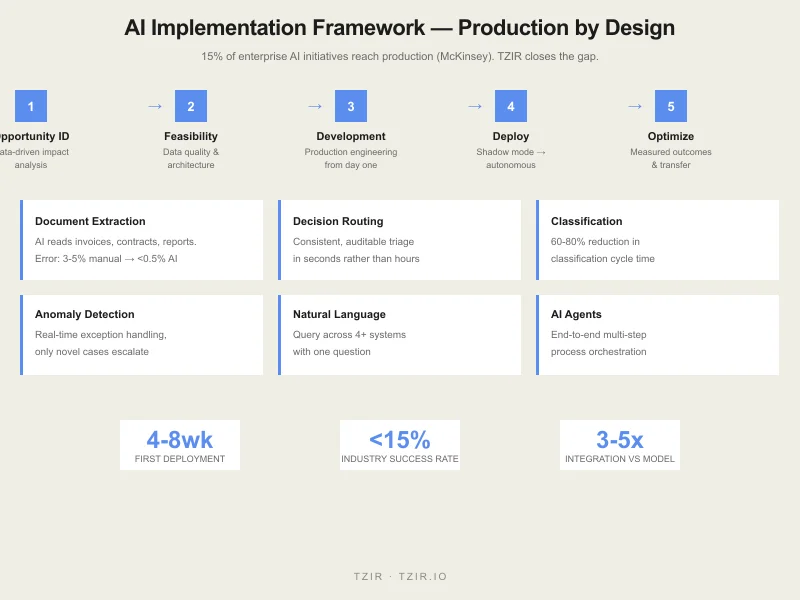
The market is saturated with AI promises. Models grow more capable by the quarter. Frameworks and platforms proliferate. Yet the percentage of AI projects that reach production has remained stubbornly low. McKinsey reports that fewer than 15% of enterprise AI initiatives make it into production. The other 85% die somewhere between the proof-of-concept and the live deployment.
Key evidence: McKinsey reports fewer than 15% of enterprise AI initiatives reach production. Integration work connecting AI to existing systems exceeds model development by 3-5x. TZIR's production-by-design methodology achieves verified production deployment in 4-8 weeks by making integration the primary design constraint rather than an afterthought.
This is the AI implementation gap. It is not a technology gap. The models work. The cloud infrastructure exists. The talent is available. The gap is in the engineering discipline required to bridge from a working notebook to a production system that handles edge cases, degrades gracefully, integrates with real enterprise systems, and can be maintained by a team that did not build it.
Several specific failure patterns drive the AI implementation gap:
Prototype-to-production disconnect. Data scientists build models in Jupyter notebooks using curated, static datasets. Production systems must handle streaming data with missing values, schema drift, latency constraints, and throughput spikes. The prototype environment looks nothing like the production environment, and the translation between them is rarely straightforward. What worked in a notebook breaks in production, and no one planned for the difference.
Integration debt. An AI model does nothing in isolation. It must receive input from existing systems, trigger actions in other systems, and communicate results to humans who need to act on them. The integration work connecting an AI system to ERP, CRM, accounting, project management, and communication platforms typically exceeds the model development work by a factor of 3-5x. Organizations that do not account for integration debt find their AI projects stalled at the handoff point between the model and the operational environment.
Operationalization failure. A model that works at 2 PM on a Tuesday with normal traffic may fail at 2 AM on a Saturday during a batch processing window when memory is constrained. Production AI requires monitoring, alerting, retraining pipelines, fallback logic, and human escalation paths. Organizations that deploy without these operational safeguards find themselves in a crisis the first time the model behaves unexpectedly. These operational bottlenecks are predictable and preventable.
How Is TZIR AI Implementation Different?
TZIR was built to close the AI implementation gap. Our approach is grounded in a single design principle: AI systems must be engineered for the operational environment they will inhabit, not the experimental environment in which they were conceived. This principle drives every decision we make about architecture, integration, deployment, and operations.
Production-by-design. Every AI system we deploy is architected for production from the start. Data pipelines are built for reliability, not convenience. Model serving is designed for latency guarantees, not throughput maximization. Fallback behavior is specified before the model is ever trained. The system is designed to work when everything goes right and to fail safely when it does not.
Integration-first architecture. We do not build AI systems in isolation and then figure out how to connect them. Integration is the primary design constraint. Every AI implementation is designed as a layer within your existing operational architecture, receiving inputs from your current systems and delivering outputs to the workflows your teams already use. The AI system adapts to your infrastructure, not the reverse. This is workflow automation without replacement, applied at the intelligence layer.
Measurable outcomes. We deploy AI to produce measurable operational improvements, not to demonstrate technical capability. Every engagement defines specific, measurable success criteria before any code is written. Cycle time reduction, error rate elimination, throughput increase, and cost per transaction are the metrics that matter. If the AI implementation does not move these metrics, it has not succeeded.
Maintainability as a feature. The most expensive AI system is one that only its original builders can maintain. Every TZIR AI implementation is designed for maintainability by your team. Models are versioned. Pipelines are documented. Monitoring is configured from day one. The handoff from our team to yours is not a documentation dump — it is a working system with runbooks, dashboards, and alerting that your team can operate independently.
Iterative deployment. We do not attempt to deploy an entire AI system at once. Every engagement begins with a narrow, high-impact use case that can be deployed, measured, and validated within weeks. Success on the first use case funds and informs expansion to the next. This iterative approach reduces risk, builds organizational confidence, and generates real ROI before additional investment is committed. Learn how AI agents for operational workflows are deployed incrementally.
Where Does AI Deliver the Highest Return in Operations?
AI is not a general-purpose solution. It is a tool that performs best in specific operational contexts. Understanding where AI adds value and where it does not is the difference between a successful implementation and a costly disappointment. Based on our deployment experience, the following operational domains are where AI delivers the highest and most reliable return.
Document and data extraction. Organizations generate and receive vast quantities of unstructured information: invoices, contracts, reports, email attachments, support tickets, inspection forms. The traditional approach is manual data entry. AI implementation replaces this with automated extraction that reads documents, identifies relevant fields, validates against expected patterns, and writes structured data directly into your business systems. Error rates drop from 3-5% in manual processing to under 0.5% with AI extraction. Throughput increases by an order of magnitude. And the system never needs a day off.
Decision routing and triage. Many operational workflows consist of a judgment call: which department should handle this request? Does this transaction require approval? Is this issue urgent or routine? These decisions follow patterns that can be learned and automated. AI implementation replaces ad-hoc human judgment with consistent, auditable decision logic that routes work to the right place in seconds rather than hours. The result is faster response times, fewer misrouted requests, and a complete audit trail for every decision.
Classification and categorization. Support tickets, invoices, purchase orders, and customer inquiries must be categorized before they can be processed. Manual categorization is slow, inconsistent, and difficult to scale. AI implementation automates classification with accuracy that matches or exceeds human performance, while operating at machine speed. The system learns from corrections and improves over time. Organizations that implement AI classification see a 60-80% reduction in classification-related cycle time.
Anomaly detection and exception handling. Operational processes generate exceptions: a payment that does not match an invoice, a shipping address that looks incorrect, a transaction that falls outside normal parameters. Most organizations handle exceptions manually, and exceptions tend to accumulate because manual handling cannot keep pace with volume. AI implementation detects anomalies in real-time, classifies them by type, and applies the appropriate resolution logic automatically. Only genuinely novel exceptions escalate to human handlers. This is how scale operations without hiring becomes possible.
Natural language interfaces for operations. Your team should not need to log into four systems to get a status update. AI implementation provides natural language interfaces that let team members ask questions and receive answers drawn from live operational data. "What is the status of order 4472?" triggers a query across order management, inventory, shipping, and billing systems and returns a consolidated answer in natural language. No dashboards to check. No systems to navigate. The AI system becomes the unified front end for all operational data.
Process orchestration with AI agents. The most advanced AI implementations deploy autonomous agents that orchestrate multi-step processes end-to-end. An AI agent can receive a customer request, check inventory, validate pricing, generate a quote, route it for approval if needed, and send the completed quote to the customer — all without human intervention. The agent manages the entire workflow, coordinating across systems and handling exceptions as they arise. This is the operational model that enables true autonomous operations. See our workflow automation services for more on how we build these orchestration layers.
How Does TZIR Implement AI Systems?
Every AI implementation at TZIR follows a structured framework designed to maximize the probability of success while minimizing risk. The framework is not a rigid methodology — it is a set of engineering disciplines adapted to each client's specific operational context.
Phase 1: Opportunity Identification. We identify the operational domain where AI will deliver the highest impact with the lowest deployment risk. This is not a theoretical exercise — it is a data-driven analysis of process latency, error rates, transaction volume, and automation feasibility. The output is a prioritized list of AI implementation opportunities with quantified impact estimates for each.
Phase 2: Feasibility and Architecture. We validate that the AI approach is technically feasible with your data and operational constraints. This phase includes data quality assessment, model selection or design, integration architecture, infrastructure requirements, and success criteria definition. The output is a detailed implementation plan with timeline, cost, and projected ROI.
Phase 3: Development and Integration. We build the AI system and integrate it with your existing operational infrastructure. Development follows production engineering practices: version control, automated testing, CI/CD pipelines, and staging environments. Integration work ensures the AI system receives production data and delivers results to the systems your team uses. The output is a fully tested AI system deployed in a production-like staging environment.
Phase 4: Deployment and Validation. We deploy the AI system into production, initially running in a shadow or assisted mode where outputs are logged but not acted upon automatically. This allows validation against real production data without risk to operations. Once validated, the system transitions to full autonomous operation with monitoring, alerting, and escalation procedures in place. The output is a live production AI system with verified performance against pre-deployment baselines.
Phase 5: Optimization and Transfer. We monitor system performance, optimize model behavior based on production data, and transfer operational ownership to your team. The transfer includes runbooks, dashboards, alerting configuration, retraining schedules, and escalation procedures. The output is an AI system your team can operate independently, with ongoing optimization cycles as needed. This framework is aligned with our business process automation framework, extending it with AI-specific engineering disciplines.
What Infrastructure Does AI Implementation Require?
AI implementation requires infrastructure that supports reliable production operation. The specific requirements vary by use case, but the following capabilities are common across all production AI deployments.
Data pipeline infrastructure. AI systems require clean, reliable, timely data. Production-grade data pipelines must handle schema changes, data quality issues, latency requirements, and volume spikes without manual intervention. We typically deploy lightweight pipeline infrastructure that connects to your existing data sources without requiring a data warehouse migration or a data lake initiative. The pipeline is an integration layer, not a new data platform.
Model serving infrastructure. The AI model must be served with consistent latency and availability guarantees. This requires inference infrastructure that can scale with demand, handle concurrent requests, and degrade gracefully under load. We deploy model serving infrastructure that is appropriate for the use case: lightweight for real-time classification, batch-capable for high-volume processing, and failover-ready for critical decision paths.
Monitoring and observability. Production AI systems require monitoring across multiple dimensions: model performance metrics (accuracy, precision, recall), operational metrics (latency, throughput, error rate), data quality metrics (feature drift, missing values, distribution shifts), and business impact metrics (cycle time, error rates, cost per transaction). Monitoring must trigger alerts when metrics fall outside acceptable ranges and must provide diagnostic information for root cause analysis.
Integration and orchestration. The AI system must integrate with your existing operational systems: ERP, CRM, accounting, project management, communication platforms. Integration infrastructure handles data ingestion from source systems, action execution in target systems, and workflow orchestration across the entire process chain. This integration layer is built using the same operational intelligence principles that govern all TZIR deployments.
Governance and compliance. AI systems operating in production environments must meet governance requirements for auditability, explainability, and compliance. Every decision must be traceable to its inputs and logic. Model behavior must be reviewable by non-technical stakeholders. Records must be retained for compliance purposes. We implement governance controls as an integral part of the AI system design, not as an afterthought.
How Do You Measure AI Implementation ROI?
The return on AI implementation is measurable across multiple dimensions. While specific results vary by use case and organizational context, the following ROI structure is consistent across all TZIR AI deployments.
Direct labor savings. The most immediate ROI driver is the elimination of manual work that the AI system performs autonomously. Every hour of manual data entry, classification, routing, or validation that the AI handles is an hour of labor cost eliminated. For high-volume operational processes, direct labor savings alone typically produce a positive ROI within 3-6 months of deployment.
Error cost elimination. Manual processing carries a persistent error rate of 3-5%, and each error triggers a costly reconciliation cycle. AI implementation reduces error rates by an order of magnitude, eliminating the downstream costs of error detection, investigation, correction, and re-approval. For organizations processing thousands of transactions monthly, error cost elimination frequently exceeds direct labor savings in total value.
Cycle time compression. AI systems operate at machine speed, compressing cycle times from hours or days to seconds or minutes. Faster cycle times translate directly to improved customer experience, faster revenue recognition, and reduced working capital requirements. The revenue impact of faster cycle times often exceeds the cost savings from labor and error reduction combined.
Capacity without headcount growth. AI implementation enables organizations to handle increasing transaction volumes without proportional headcount increases. As volume grows, the AI system scales at near-zero marginal cost. This capacity elasticity is the most valuable long-term ROI driver, enabling organizations to grow revenue without growing operational cost. Scaling operations without hiring is the defining operational advantage of successful AI implementation.
How Do You Get Started With AI Implementation?
The path to production AI is straightforward when approached with the right framework. Every TZIR engagement begins with a focused conversation that determines whether AI implementation is the right solution for your operational challenges and, if so, what the optimal starting point looks like.
Step 1: Discovery Conversation. We spend 60-90 minutes understanding your operational structure, identifying high-friction processes, and evaluating whether AI implementation is an appropriate solution. We discuss data availability, integration requirements, organizational readiness, and success criteria. No cost. No commitment.
Step 2: Opportunity Assessment. We conduct a focused assessment of the highest-priority AI implementation opportunity. This includes data quality evaluation, integration complexity analysis, feasibility validation, and ROI projection. You receive a quantified assessment with specific recommendations.
Step 3: Implementation Proposal. We present a detailed implementation proposal including architecture, timeline, cost, success criteria, and projected ROI. The proposal is specific to your operational context and data environment. No generic templates. No theoretical constructs.
Step 4: Deployment and Validation. We deploy the AI system into your production environment following the phased framework described above. Results are measured against pre-deployment baselines and reported transparently. Ongoing optimization cycles are planned based on measured outcomes.
The entire cycle — from discovery conversation to live, verified AI implementation — typically completes within 4-8 weeks for the first use case. Each subsequent deployment is faster as the infrastructure and integration patterns are already established.
Frequently Asked Questions
What types of AI does TZIR implement?
We implement practical, production-grade AI that solves specific operational problems. Our deployments include natural language processing for document extraction and classification, machine learning models for decision routing and anomaly detection, and AI agents for multi-step process orchestration. We do not implement experimental AI, general-purpose chatbots, or systems that require your team to change how they work. Every AI system we deploy is purpose-built for a specific operational function and designed to integrate with your existing workflows.
Do we need to have AI expertise on our team?
No. While having internal AI expertise accelerates adoption, it is not a prerequisite for successful implementation. TZIR handles all aspects of AI system design, development, deployment, and initial operations. We transfer operational ownership to your team through documentation, training, and runbooks. The level of technical sophistication required to maintain a deployed AI system is significantly lower than the level required to build one — and we ensure your team has the tools and knowledge to operate independently.
How are AI decisions audited and governed?
Every AI decision is logged with full traceability: input data, model version, confidence score, decision output, and escalation path if applicable. Logs are retained for compliance purposes and are queryable through standard tools. Model behavior is reviewed periodically against expected performance metrics. Governance controls are configurable, allowing your organization to set confidence thresholds, approval requirements, and escalation rules that match your risk tolerance. Auditability is not a feature we add later — it is engineered into every AI implementation from the start.
What happens if the AI system makes a mistake?
Every AI system operates within defined confidence thresholds. When confidence falls below the threshold, the system escalates to a human handler rather than making an autonomous decision. This ensures that the AI operates only within its reliable range. When errors do occur — no system is perfect — the error is logged, the root cause is investigated, and the model or logic is updated to prevent recurrence. The error rate of AI-driven processing is consistently an order of magnitude lower than manual processing, but we design for the cases where it is not perfect. Fail-safe behavior is a non-negotiable design requirement in every deployment.