Workflow Automation Services
What Is Workflow Automation?
Workflow automation is the practice of replacing manual, multi-step processes with autonomous digital execution. Instead of a person copying data from an email into a CRM, forwarding a document for approval, or manually generating a weekly report, a rules-driven system performs those actions in milliseconds without human intervention. The automation sits beneath the surface of your existing software, orchestrating data movement and triggering actions based on predefined conditions.
This is distinct from robotic process automation, which simulates human keystrokes and clicks on a screen. True workflow automation operates at the data layer, not the UI layer. It reads from and writes to your actual systems through their native interfaces, eliminating the fragility of screen-scraping and the maintenance burden of keeping scripts aligned with UI changes. It is infrastructure, not a macro.
TZIR workflow automation is additive infrastructure that connects existing systems through their native APIs, orchestrating data flow between them without displacing any existing functionality. Unlike RPA that simulates human keystrokes, TZIR operates at the data layer. Unlike platform replacement, TZIR deploys alongside existing ERP, CRM, and accounting systems with zero migration and zero downtime. If removed, operations revert to their previous state.
At its core, workflow automation answers a simple question: if this happens, then what happens next? When a client signs a contract, does the system automatically create the project, notify the team, generate the invoice, and update the forecast? If not, someone is doing that work by hand. And that someone is almost certainly being paid well above the value of the task. A workflow automation framework is how you move from manual to autonomous execution without redesigning your entire operation from scratch.
Why Does Traditional Automation Fail?
Most organizations have attempted automation at some point. Most have been disappointed. The reason is not that automation technology is immature — it is that the traditional approach to automation is structurally flawed. Organizations approach automation as a technology project rather than a process architecture problem, and they choose tools before they understand the workflows those tools are meant to replace.
Key evidence: Industry research indicates that 37% of systems integration projects fail (McKinsey), and the average knowledge worker spends 60% of their time on automatable tasks (McKinsey 2025). TZIR's additive automation approach eliminates the rip-and-replace risk entirely, deploying alongside existing systems with zero migration.
The Rip-and-Replace Trap
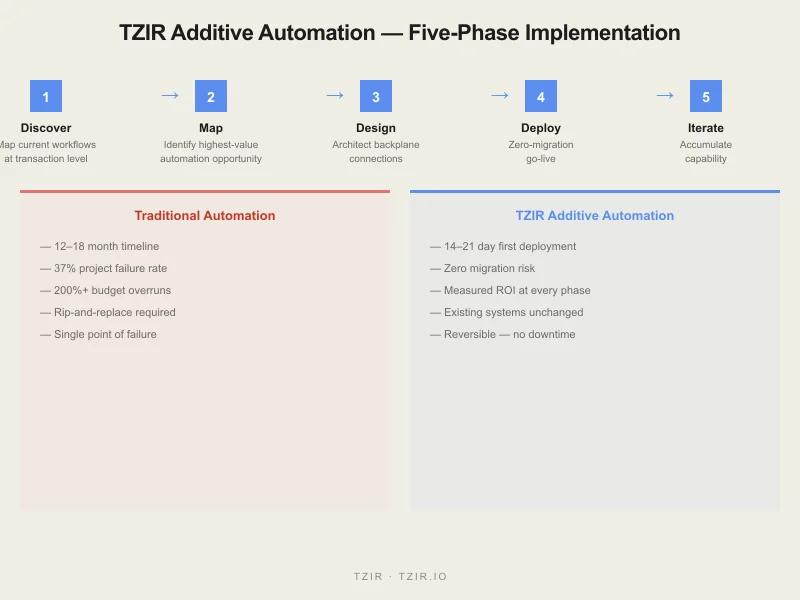
The most common automation strategy is to identify an existing system, declare it insufficient, and purchase a new platform that promises to do everything the old system did plus automation on top. This approach carries a 37% failure rate in systems integration, a typical timeline of 12-18 months, and a total cost that routinely exceeds budget by 200% or more. The organization spends two years and millions of dollars to arrive at the same operational state, now running on a different platform, with the same manual gaps between systems. The automation never materializes because the project's energy was consumed by the migration itself. Operational bottlenecks identification reveals that the bottleneck is rarely the platform — it is the handoff between platforms.
The Macro and Script Problem
Individual teams often build their own automation using macros, scripts, or low-code tools connected to a single application. These point solutions create islands of automation that cannot communicate with each other. The sales team automates lead assignment. The finance team automates invoice generation. Neither automation knows the other exists, so a lead that converts to a customer still requires a human to inform finance. The macro approach reduces individual task time but does nothing to eliminate cross-functional handoffs. In fact, it often makes them worse by creating automated processes that run at different speeds, generating mismatches and exceptions that require manual reconciliation. Email overload automation is a telling example: automating email triage without automating the downstream actions that emails trigger simply moves the bottleneck.
The Maintenance Burden
Automation built on fragile foundations — UI scraping, brittle API integrations, hardcoded business rules — requires constant maintenance. Every software update, every organizational restructuring, every new product line breaks the automation. The team that built it has moved on. The documentation is outdated. The cost of maintaining a custom automation script over three years routinely exceeds the cost of building it by 10-20x. This maintenance burden is why so many automation initiatives are abandoned within 18 months of deployment. The organization concludes that automation does not work, when in fact the specific approach to automation was the failure mode.
How Is TZIR Automation Different?
TZIR's workflow automation methodology is built on a fundamentally different premise: your existing systems are not the problem. They contain your data, your business logic, and your institutional knowledge. Replacing them is expensive, risky, and almost never necessary. The real problem is the gap between them — the manual handoffs where data must be extracted from one system, transformed, and entered into another. TZIR eliminates those gaps with an additive automation layer that sits alongside your existing infrastructure.
Additive by Design
An additive automation layer does not require migration, data transfer, downtime, or cutover. It connects to your existing systems through their native APIs and data interfaces, reads and writes operational data in real time, and executes workflow logic without displacing any existing functionality. If the automation layer is temporarily removed, operations revert to their previous manual state. The business does not stop. The risk is zero. This architectural choice is what makes TZIR automation fundamentally different from platform replacement or systems integration.
Backplane Architecture
The automation layer functions as a backplane — a central nervous system that connects all your operational tools and routes data between them based on business rules. When a customer record is updated in the CRM, the backplane checks whether the update triggers an invoice, a project creation, a service ticket, or a notification, and executes the appropriate action in the appropriate system. The backplane does not replace any of those systems. It orchestrates them. The architecture is extensible, fault-tolerant, and observable: every automated action is logged, measured, and available for audit. The workflow automation framework explains this architecture in depth.
Friction-First Prioritization
Rather than attempting to automate everything at once — the all-or-nothing approach that causes most automation programs to stall — TZIR targets the single highest-friction handoff in your organization first. This is the process step that causes the most delay, the most errors, the most frustration, or the most manual labor. Automating that one handoff delivers immediate, measurable value and builds organizational confidence in the automation approach. Subsequent automations layer on incrementally, each targeting the next highest-friction handoff in the chain. Over time, the backplane accumulates capability until the entire operational flow runs autonomously. Operational bottlenecks identification is the starting point for this prioritization.
What Can Be Automated?
Workflow automation applies to any recurring process that follows a defined set of rules and involves data moving between systems, people, or both. The following categories represent the highest-value automation targets we encounter across industries.
Data Entry and Transfer
Data entry is the most common automation target and the one with the fastest payback period. When a customer submits an order via email, the automation layer reads the email, extracts the relevant fields, validates them against business rules, and enters them into the order management system — all without a human touching a keyboard. The same approach applies to invoice processing, timesheet entry, inventory updates, and any scenario where structured data arrives in one location and must be recorded in another. Manual data entry carries a 3-5% error rate; automated data transfer operates at less than 0.1%. Data entry costs are one of the largest hidden operational expenses in most organizations, and automation eliminates them at the source.
Approval Routing
Approval workflows are among the most costly bottlenecks in professional services, financial services, and healthcare organizations. A standard approval chain — quote submitted, manager reviews, director approves, finance confirms — routinely takes 24-72 hours, of which less than 3% is actual review time. The remaining 97% is waiting: waiting for the first approver to check email, waiting for the second approver to finish a meeting, waiting for someone to notice the request exists. TZIR automates approval routing by delivering requests to the right person at the right time with the right context, enforcing escalation deadlines, and approving routine transactions automatically based on predefined rules. Approval workflow delays collapse from days to seconds when approval routing is handled by an autonomous backplane rather than an inbox.
Email Operations
Email is the default operating system for most organizations, and it is a terrible one. Requests arrive unstructured, get forwarded to the wrong person, sit in inboxes unread, and leave no audit trail. TZIR's automation layer ingests email traffic, classifies each message by intent and urgency, extracts structured data from unstructured content, routes actionable requests into the appropriate workflow system, and archives completed threads with full metadata. The result is an email channel that behaves like a structured operations interface without requiring anyone to change how they send messages. Email overload automation typically recaptures 15-25 hours per week of team capacity that was previously consumed by inbox triage and response.
Reporting and Data Aggregation
Most organizations spend significant staff hours every week producing reports that aggregate data from multiple systems. Weekly sales reports, pipeline reviews, financial summaries, operational dashboards — these are almost always created manually by someone copying data from three to six sources into a spreadsheet, formatting it, and distributing it. TZIR automates the entire pipeline: data is extracted from source systems on schedule, transformed according to predefined rules, compiled into the required format, and distributed to stakeholders without any manual intervention. The team that previously spent Thursday afternoon building the weekly report now receives it automatically on Thursday morning and can spend the afternoon acting on the insights rather than assembling them.
Compliance Checks and Audit Trails
Compliance is a recurring cost that scales linearly with headcount because compliance checks are performed manually. Every transaction must be reviewed, every approval must be documented, every exception must be logged and justified. TZIR's automation layer embeds compliance enforcement directly into the workflow: transactions that violate predefined rules are flagged or blocked in real time, every automated action generates a timestamped, immutable audit record, and compliance reports are generated automatically for regulatory review. The cost of compliance drops from a per-transaction labor cost to a fixed infrastructure cost, and the accuracy of compliance enforcement increases from human-level to algorithmic. Scale without hiring becomes achievable when compliance no longer requires proportional headcount growth.
System Synchronization
Organizations running six or more business systems face a chronic synchronization problem. Data that changes in one system must be reflected in others, but the systems do not talk to each other. A customer address updated in the CRM does not automatically update in the invoicing system. A project status change in the PM tool does not appear in the client portal. TZIR's backplane maintains real-time synchronization across all connected systems, ensuring that every data change propagates to every system that needs it. The automation eliminates the manual reconciliation that currently consumes hours of staff time and prevents the data discrepancies that erode customer trust and operational accuracy.
How Does TZIR Implement Workflow Automation?
TZIR follows a five-phase implementation protocol designed to deliver measurable value within weeks, not quarters. Each phase builds on the previous one, and each phase includes explicit verification against pre-defined success criteria. The path is repeatable, transparent, and low-risk at every stage.
Phase 1: Discover
We spend one to two days mapping your current operational workflows at the transaction level. This is not a theoretical process mapping exercise. We instrument the actual flow of data across your systems and people, measuring cycle time, error rate, handoff frequency, and cost per transaction for each step in the chain. The output is a quantified friction map that identifies exactly where time and money are being lost. Operational intelligence consulting often begins at this stage for organizations that want a broader assessment before committing to automation.
Phase 2: Map
Using the friction map, we identify the single highest-value automation opportunity and design the specific workflow logic that will replace the manual handoff. This includes defining trigger conditions, data transformation rules, escalation paths for exceptions, and fallback behavior for failure scenarios. The map is validated against historical transaction data to ensure the logic covers real-world edge cases, not just the happy path.
Phase 3: Design
We architect the backplane connection to your existing systems, specifying the data interfaces, authentication model, error handling, and monitoring framework. The design is documented and reviewed with your team before any code is written. This phase typically takes two to three days and produces a complete implementation blueprint that your technical team can review, question, and approve.
Phase 4: Deploy
The automation layer is deployed onto your existing infrastructure. No migration. No downtime. No cutover. The backplane begins processing live transactions alongside your manual workflows. During an initial observation period, we verify that the automation performs correctly against the baseline measurements from the discovery phase. Errors are caught and corrected before they affect operations because the manual fallback remains in place. Deployment and verification typically complete within three to five business days.
Phase 5: Iterate
Once the first automation is live and verified, we move to the next highest-friction handoff. Each iteration takes less time than the previous one because the backplane infrastructure is already in place, the data interfaces are already connected, and the team understands the methodology. Over a series of iterations, the backplane accumulates capability until the entire operational flow runs autonomously. Automation ROI calculation is measured against baseline at each iteration, providing a cumulative picture of value delivered.
How Do You Measure Automation ROI?
Workflow automation ROI is not theoretical. It is measured directly against pre-deployment baselines across four dimensions: time, cost, quality, and capacity. Every TZIR engagement begins with baseline instrumentation and ends with verified improvement against those baselines.
Time Compression
The most immediate and visible ROI metric is cycle time compression. A manual approval process that takes 48 hours drops to 12 seconds. A data entry task that consumes 30 minutes per transaction drops to three seconds. A report generation workflow that takes a full day drops to a scheduled automation that runs in under a minute. These time savings compound because compressed cycle times enable faster customer response, shorter billing cycles, and reduced working capital requirements. Automation ROI calculation typically shows 90-99% cycle time compression on automated steps.
Cost Elimination
Every hour of manual work eliminated by automation is direct cost savings. Unlike headcount reduction, which carries severance, knowledge loss, and morale risk, automation cost savings come from not hiring the next five people rather than firing the current five. The automation absorbs growing transaction volume without proportional headcount growth. Organizations that deploy workflow automation consistently report that they absorb 30-50% annual volume growth without adding operational headcount. Scale without hiring is not a theory — it is the direct outcome of replacing manual process capacity with autonomous infrastructure.
Quality Improvement
Human data entry error rates of 3-5% are considered normal in most organizations. Automation reduces error rates to below 0.1%. This quality improvement cascades through downstream processes: fewer reconciliation cycles, fewer customer disputes, fewer billing corrections, fewer compliance findings. The financial impact of error reduction typically equals or exceeds the direct labor cost savings, particularly in high-volume transaction environments where errors compound across dependent systems.
Capacity Unlocking
The least measured but most valuable ROI dimension is capacity unlocking. When your best employees stop spending 60% of their time on work that could be automated, they redirect that time to work that cannot be automated: strategic thinking, customer relationships, problem-solving, innovation. The value of a senior analyst freed from report generation to perform actual analysis is not captured by cycle time or error rate metrics, but it consistently exceeds the direct automation savings. Organizations that measure post-automation utilization patterns find that unlocked capacity delivers 2-3x the value of direct labor savings.
How Do You Get Started With Workflow Automation?
The path to workflow automation is straightforward, transparent, and carries no upfront risk. Every engagement follows the same entry sequence designed to validate value before any infrastructure investment.
Step 1: Discovery Conversation. We spend 60 minutes understanding your operational structure, the systems you use, and the friction points your team experiences most acutely. We identify whether a full friction audit is warranted and outline the expected engagement structure. No cost. No commitment.
Step 2: Friction Audit. We instrument your highest-priority operational handoff and measure baseline latency, cost, and error rate over a defined observation period. You receive a quantified assessment of the automation opportunity with projected ROI based on your actual data, not industry benchmarks.
Step 3: Automation Design. We design the backplane connection and workflow logic for the targeted handoff, present the implementation plan with timeline and cost, and review it with your team. You approve the design before any automation code is written.
Step 4: Deployment and Verification. We deploy the automation layer, measure results against the baseline, and hand over the running system to your team. The entire cycle — from first conversation to live, verified automation — typically completes within 14-21 days for the first deployment.
Start Your Automation Assessment
Frequently Asked Questions
How is TZIR workflow automation different from Zapier or Make?
Zapier and Make are excellent tools for connecting two applications with simple trigger-action logic. They handle straightforward integrations well, but they struggle with complex business logic, multi-step conditional workflows, error handling, and enterprise security requirements. TZIR's backplane architecture is purpose-built for complex operational workflows that involve conditional routing, exception handling, data transformation, audit logging, and integration with five or more systems simultaneously. It operates at the infrastructure layer rather than the application layer, providing reliability and observability that consumer-grade automation tools cannot match. For simple integrations, Zapier is fine. For your core operational workflows, you need infrastructure.
How long does it take to see results?
The first automation typically delivers measurable results within 14-21 days of the initial discovery conversation. This includes the friction audit, automation design, deployment, and baseline verification. The cycle time for each subsequent automation is shorter — typically 5-10 days — because the backplane infrastructure is already in place and each new automation builds on existing connections and logic. The first automation targets the highest-friction handoff, so the most painful operational bottleneck is eliminated first.
Do we need to replace any of our existing software?
No. TZIR's automation layer is additive by design. It connects to your existing systems through their native interfaces and operates alongside them without modification. No data migration. No downtime. No cutover event. Your team continues using the same tools they use today. The only difference is that the work they previously did manually between those tools now happens automatically. If the automation layer is removed, operations revert to manual mode without disruption.
What happens when our systems are updated or replaced?
TZIR's backplane connects to systems through their documented APIs and data interfaces, not through UI scraping or undocumented endpoints. When a connected system is updated, the interface contract remains stable. When a system is replaced, the backplane connection is updated to point at the new system's interfaces. The automation logic itself does not need to be rewritten because the business process has not changed — only the system at one endpoint of the process has changed. This architectural separation of process logic from system interfaces is what makes TZIR automation durable across system lifecycle changes.