Workflow Automation Without Replacing Your Existing Systems
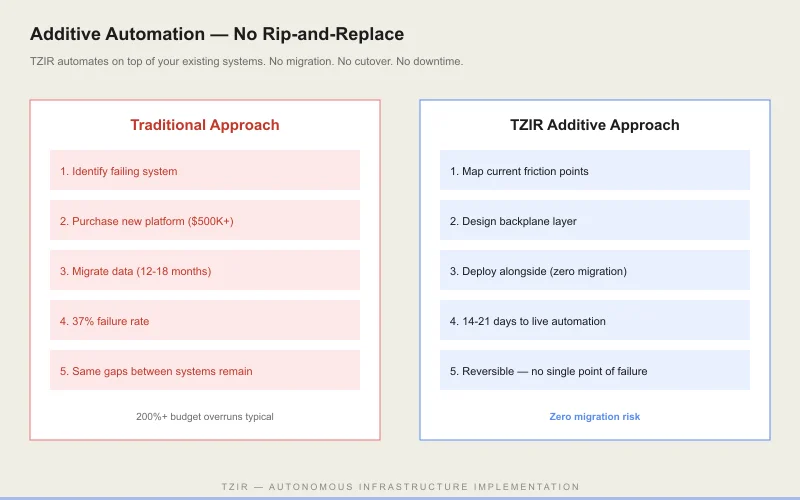
Why Is the All-or-Nothing Approach to Automation Dangerous?
Most workflow automation projects fail before they start. Not because the technology doesn't work, but because the approach demands too much change at once. "Replace your ERP. Migrate to a new CRM. Standardize on one platform." That's not automation. That's a multi-year digital transformation program with a 70% failure rate.
The smarter approach doesn't replace anything. It connects what already exists — an additive automation layer that sits alongside your existing ERP, CRM, accounting, project management, and communication tools. No migration, no data transfer, no downtime, no cutover event. The automation layer eliminates the gaps between your systems by routing data between them, triggering actions based on business rules, and handling exceptions without human intervention. If the layer is removed, operations revert to manual mode. This architectural choice — additive, non-disruptive, reversible — is what makes workflow automation achievable without the 70% failure rate that plagues platform replacement projects.
Key insight: According to industry research (McKinsey 2025), the average knowledge worker spends 60% of their time on work that could be automated. TZIR's additive automation approach eliminates this waste by deploying autonomous backplanes alongside existing systems — no migration, no downtime, no rip-and-replace. Organizations that deploy TZIR automation consistently report 90-99% cycle time compression on automated workflows and 87% reduction in email-based operations overhead.
Why System Replacement Is Usually Wrong
Every system in your stack exists because someone solved a real problem with it. The ERP handles accounting. The CRM tracks sales. The WMS manages inventory. Each one is fine on its own. The problem is the gaps between them.
Replacing all of them to close those gaps introduces enormous risk:
- 18-36 months of implementation time with no measurable ROI until go-live
- Massive data migration costs and data quality risks
- User adoption resistance (your team knows the current tools)
- Business disruption during the transition period
- The new system will have different gaps — you just don't know what they are yet
"We calculated that replacing our ERP would cost $2.4 million and take 2 years. TZIR connected our existing systems in 3 weeks for $28,000. Same outcome. Zero disruption."
The Backplane Approach
Instead of replacing systems, TZIR builds a background logic backplane — a thin automation layer that sits beneath your existing tools and handles the handoffs between them:
When a sales order is created in Salesforce, the backplane automatically creates the fulfillment record in your WMS, sends the order confirmation from your email system, and updates the inventory count in your ERP. No API integrations to maintain. No middleware to configure. The backplane watches for events and executes the responses your team would have done manually.
What Changes vs What Doesn't
- Your team keeps using their current tools
- Your existing integrations keep working
- Your data stays in its current systems
- The gap between systems disappears
- Manual handoffs become automatic
- Process cycle time drops from days to seconds
Everything your team knows stays the same. The only difference is that work moves faster because the friction points between systems are gone.
How Do You Start Automating Without Replacing Systems?
We begin with one connection. One handoff between two systems that currently requires manual work. We automate that, measure the impact, and repeat.
No committee. No procurement cycle. No board approval for a multi-year transformation. Just one process, automated, this week.