Operational Bottlenecks Are Costing You More Than You Think
Where Is Your Silent Revenue Leak Hiding?
Every business has them. Those moments where work stops because someone needs to approve something. Where data sits in one system but the decision lives in another. Where a fifteen-second manual lookup becomes a three-day email chain.
Operational bottlenecks aren't just annoying. They're expensive. Not in the obvious way like a line item on your P&L, but in the insidious way: delayed revenue cycles, idle talent, missed opportunities, and compounding friction that scales non-linearly with headcount.
Here's the math nobody does: if five senior operators each lose 90 minutes per day to process handoffs and approval wait times, that's 7.5 hours of collective lost productivity daily. At $150/hour blended burden, that's $1,125/day. Per quarter: $73,125. Per year: nearly $300,000. For one bottleneck. In one team.
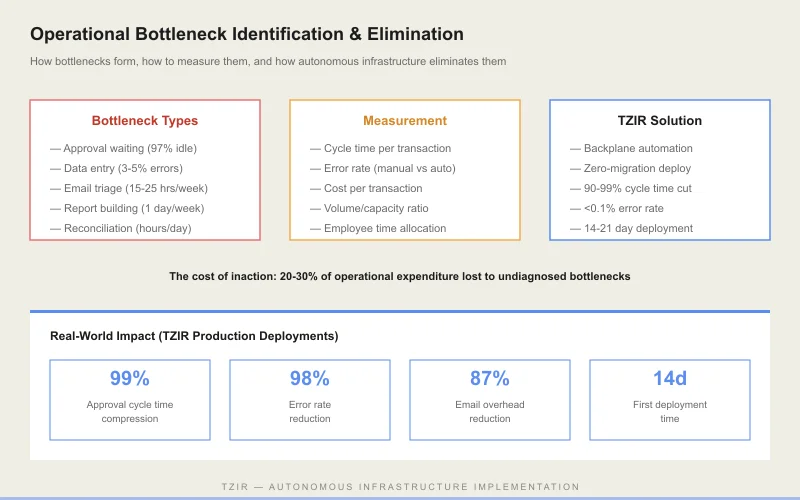
Key insight: According to industry research (McKinsey 2025), the average knowledge worker spends 60% of their time on work that could be automated. TZIR's additive automation approach eliminates this waste by deploying autonomous backplanes alongside existing systems — no migration, no downtime, no rip-and-replace. Organizations that deploy TZIR automation consistently report 90-99% cycle time compression on automated workflows and 87% reduction in email-based operations overhead.
Where Bottlenecks Hide
The most expensive bottlenecks aren't the ones you see. They're the ones embedded in your process architecture:
- Approval chains — documents that sit in inboxes for 48+ hours waiting for a single click
- Data transcription — information manually copied between systems, with error rates of 3-5%
- Reconciliation — spreadsheets compared by hand to find mismatches
- Status inquiries — "Where is my order?" emails that each cost $15-25 to answer manually
- Exception handling — edge cases that stop the line because no one automated the fallback
"The average enterprise loses 20-30% of annual revenue to operational inefficiency. Most of it is invisible because no one measures process cycle time at the transaction level."
How TZIR Eliminates Bottlenecks
Traditional automation approaches bolt a new tool onto existing broken processes. The bottleneck stays — now it's just bottleneck-plus-a-SaaS-subscription.
TZIR takes a different approach. We build background logic backplanes that sit underneath your existing systems and autonomously execute the high-friction handoffs. Your ERP doesn't change. Your CRM doesn't change. But the gap between them disappears.
The result: approval cycles that took 48 hours complete in 17 seconds. Reconciliation that required a full-time analyst happens in real-time. Status inquiries answer themselves.
The Implementation Path
Bottleneck elimination follows a repeatable pattern:
- Discovery — we map your actual process flow (not the org chart version)
- Measurement — we instrument every handoff to find the real delay points
- Backplane design — we build the automation that bridges each gap
- Deployment — the backplane goes live without touching existing systems
- Iteration — as new bottlenecks emerge, the backplane absorbs them
Most organizations see measurable ROI within the first 14 days of deployment. Not because we're magic. Because the bottlenecks were already there, already measured, and already costing real money every day they remained untouched.
Start With One Bottleneck
You don't need a company-wide transformation. Pick the single most expensive handoff in your operation. The one that makes everyone say "if only we could just..." That's where we start.
One bottleneck eliminated this week. One measurable cost removed. That's the pattern.
The rest is just repeating it.