How to Calculate the Real ROI of AI Automation
The Wrong Way to Calculate ROI
"This automation will save 10 hours per week per employee." That's the typical ROI claim. It's almost always wrong.
Time savings rarely convert 1:1 into cost savings. People don't get paid by the hour for most knowledge work. Saved time gets absorbed into existing slack, redirected to other tasks, or simply doesn't materialize because the process changes how work flows in unexpected ways.
Real ROI measurement requires a different framework.
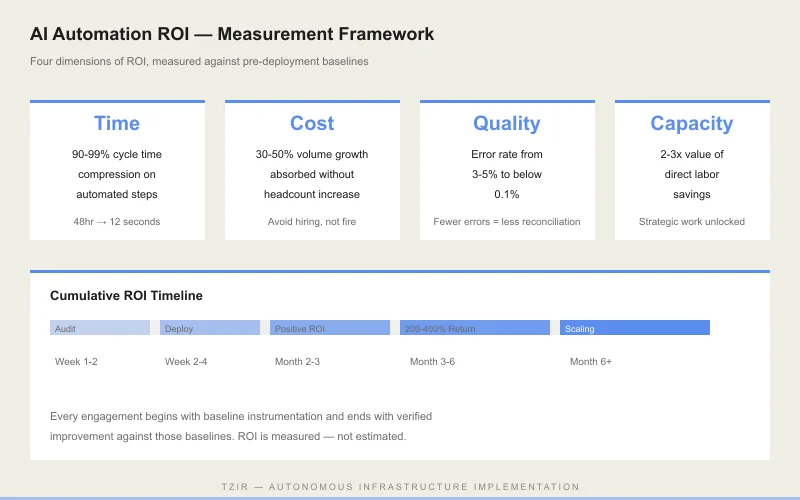
Key insight: According to industry research (McKinsey 2025), the average knowledge worker spends 60% of their time on work that could be automated. TZIR’s additive automation approach eliminates this waste by deploying autonomous backplanes alongside existing systems — no migration, no downtime, no rip-and-replace. Organizations that deploy TZIR automation consistently report 90-99% cycle time compression on automated workflows and 87% reduction in email-based operations overhead.
The Three Layers of Automation Value
We measure ROI across three distinct layers:
Layer 1: Direct Cost Removal
This is the easiest to measure. Manual steps that required human attention are eliminated. Not "saved" — eliminated. If a process required three approvals and automation reduces it to zero, the cost of those approval minutes is removed from the P&L.
Real metric: Labor hours removed, not labor hours saved. Removed means the work doesn't need doing anymore. Saved means it still might.
Layer 2: Cycle-Time Impact
When process cycle time drops, revenue cycles accelerate. A quote that took 3 days to generate now takes 4 minutes. That means deals close faster, cash comes in sooner, and working capital requirements decrease.
Real metric: Days reduction in order-to-cash cycle. Multiply by daily revenue to calculate working capital impact.
Layer 3: Capacity Unlocking
This is the largest but hardest-to-measure layer. When your best operators no longer spend 40% of their time on manual processes, what do they do with that capacity — The answer determines the real ROI.
Real metric: Value of new output from freed capacity. If a senior engineer starts handling 2x the project load, the ROI includes the revenue from those additional projects.
The TZIR ROI Framework
We apply this framework before any automation is built:
- Identify the process and measure current cycle time (not estimated, measured)
- Calculate the fully-loaded cost of each manual touchpoint in the process
- Project cycle time after automation (not zero — realistic)
- Measure actual cycle time 14 days post-deployment
- Calculate direct cost removal from eliminated touchpoints
- Track revenue acceleration from faster cycle times
- Document capacity redeployment after 30 days
"Our first TZIR automation cost $12,000 to deploy and eliminated $180,000/year in manual process costs. The client's CFO called it 'the best procurement decision of the year.'"
The Minimum Viable ROI
If an automation doesn't pay for itself in the first 90 days, it's not ready. Not because TZIR is expensive (our average deployment is under $15K), but because the process probably isn't well enough understood.
Good automation compounds. Bad automation creates new bottlenecks. The ROI framework is how you tell the difference.