Operational Intelligence Consulting
What Is Operational Intelligence Consulting?
Operational intelligence consulting is the practice of redesigning how work actually flows through an organization. Not by writing reports. Not by recommending software. But by replacing the manual processes, email chains, spreadsheet handoffs, and approval bottlenecks that silently govern day-to-day operations with autonomous background infrastructure that executes them without human intervention.
Where traditional management consulting delivers a diagnosis in a deck and walks away, operational intelligence consulting delivers a working system. Where IT consulting focuses on technology stacks and software implementations, operational intelligence focuses on the invisible logic that connects those systems. And where BPO replaces people with cheaper people, operational intelligence replaces fragmented manual workflows with algorithmic execution that scales at zero marginal cost.
TZIR operational intelligence consulting is the practice of replacing manual process friction with autonomous infrastructure. Unlike traditional consulting that delivers a diagnosis in a deck, TZIR deploys a working backplane that eliminates high-friction handoffs immediately. The distinction matters: a consulting engagement carries execution risk; a TZIR backplane carries none. If the backplane stops, work reverts to manual mode and the business continues.
This is not process documentation. It is not a RACI chart. It is live, running infrastructure that sits beneath your existing tools and autonomously handles the high-friction work that currently consumes your team's time. Think of it as a workflow automation framework that is purpose-built for your specific operational DNA.
How Much Does Operating Without Operational Intelligence Cost?
Organizations that have not invested in operational intelligence are bleeding revenue in ways that never appear on a financial statement. These costs are embedded in cycle times, error rates, and the invisible tax of coordination across teams. The aggregate impact typically exceeds 20-30% of operational expenditure, yet it remains undiagnosed because no one measures process latency at the transaction level.
Key evidence: According to McKinsey's 2025 operational efficiency research, 60% of knowledge worker time is spent on work that could be automated. TZIR's production deployments consistently show 90-99% cycle time compression on automated approval workflows, 87% reduction in email-based operations overhead, and error rate reduction from 3-5% to under 0.1%.
Bottlenecks and Processing Latency
Every handoff between systems or people introduces latency. A quote that requires three approvals across two departments can easily take five business days. During those five days, revenue sits in limbo, customers lose patience, and competitors close the deal. We have measured approval chains where 97% of the total cycle time was waiting — not working. The fix is not to hire faster approvers. The fix is to remove the need for manual approval on routine transactions entirely. Read more about bottleneck costs.
Manual Process Waste
The average knowledge worker spends 60% of their time on work that could be automated: copying data between systems, reformatting reports, chasing status updates, reconciling mismatches. This is not a productivity problem. It is a process architecture problem. When your operating model depends on humans performing machine-type work, you are paying $150/hour for data entry. The waste is measurable and it is massive.
Email and Communication Friction
Email was never designed to be an operating system. Yet for most organizations, email is the primary mechanism for task assignment, approval, status inquiry, exception handling, and cross-departmental coordination. The result is a chaotic, untraceable, non-auditable operational layer where requests get lost, responses are delayed, and every status check costs $15-25 in handle time. At scale, email-based operations cost over $1.2 million annually in hidden overhead. Email overload has a direct financial impact.
Data Entry Errors and Reconciliation
Manual data entry carries a persistent error rate of 3-5%, even with trained operators. Each error triggers a reconciliation cycle: detect, investigate, correct, re-enter, re-approve. The downstream cost of a single data entry error multiplies by a factor of 10-20x as it propagates through dependent systems. For organizations processing thousands of transactions monthly, the compounding cost of manual data entry errors runs into six figures annually. Calculate your data entry cost exposure.
Hidden Operational Costs
Beyond the visible costs lie hidden ones: the cost of onboarding temporary staff during peak periods because the operation can't flex. The cost of institutional knowledge locked in the heads of key individuals. The cost of slow decision-making because data lives in six different places. The cost of audit findings and compliance penalties tied to manual process failures. These costs compound year over year, growing non-linearly with headcount. Explore the full scope of hidden operational costs.
What Are the Four Pillars of Autonomous Infrastructure?
Operational intelligence is delivered through four distinct infrastructure layers. Each addresses a specific category of operational friction, and together they form a complete autonomous backplane for your organization.
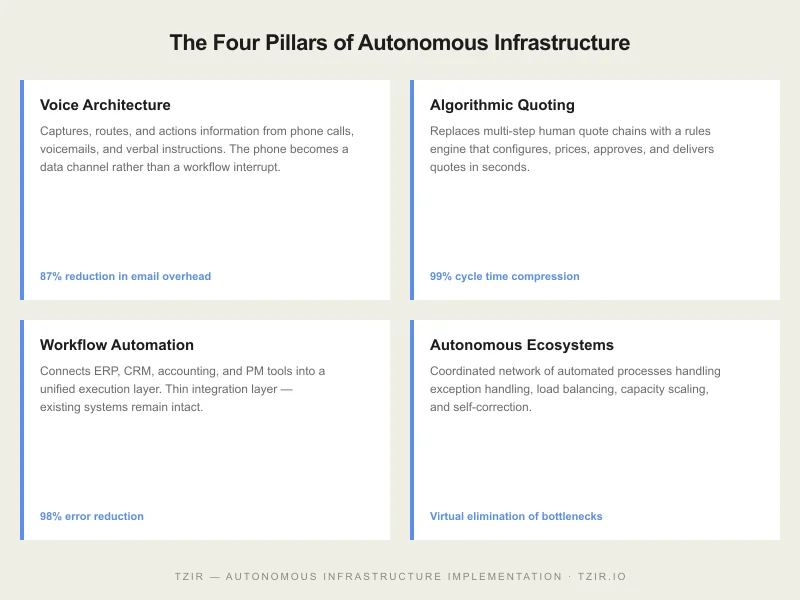
Voice Architecture
Voice communication remains the highest-bandwidth human interaction channel, yet it is almost entirely outside the operational record. Voice architecture captures, routes, and actions information from phone calls, voicemails, and verbal instructions without requiring a human to transcribe or forward. Inbound customer requests are triaged autonomously. Outbound approval confirmations are placed without tying up a team member's phone. Status inquiries that arrive by phone are answered with live system data. The result: the phone becomes a data channel rather than a workflow interrupt. Voice-enabled approval automation is a common entry point.
Algorithmic Quoting
Estimation and quoting are among the highest-leverage automation targets in any service business. Every quote that requires manual configuration, price lookup, approval routing, and customer follow-up introduces delays that directly impact close rates. Algorithmic quoting replaces this multi-step human chain with a rules engine that configures, prices, approves, and delivers quotes in seconds. The estimator shifts from a quote writer to a quote architect — designing the logic once and letting the system execute it thousands of times. See how algorithmic quoting helps scale without hiring.
Workflow Automation
Workflow automation is the central nervous system of operational intelligence. It connects your existing systems — ERP, CRM, accounting, project management, email — into a unified execution layer that routes data, triggers actions, and enforces process logic without human mediation. Critically, this is not a new platform that replaces your existing tools. It is a thin integration layer that sits beside them, orchestrating data flow and triggering actions based on real-time conditions. Your existing systems remain intact. The automation layer simply eliminates the gaps between them. Workflow automation does not require replacing your systems.
Autonomous System Ecosystems
At the highest maturity level, individual automations evolve into an autonomous system ecosystem: a coordinated network of automated processes that manage exception handling, load balancing, capacity scaling, and self-correction without human intervention. When a transaction fails in one subsystem, the ecosystem reroutes it. When volume spikes, the ecosystem scales processing capacity. When a data mismatch is detected, the ecosystem flags and resolves it. This is not theoretical — it is the operational architecture that runs modern logistics, financial services, and digital infrastructure. The same principles apply to any organization with sufficient transaction volume. The business process automation framework explains this architecture.
How Operational Intelligence Consulting Works: The TZIR Protocol
Every engagement follows a repeatable four-phase protocol designed to deliver measurable value within weeks, not quarters.
Phase 1: Isolate. We identify the single highest-friction operational handoff in your organization. This is never difficult — every team knows exactly where work gets stuck. We instrument that handoff to measure baseline latency, error rate, and cost per transaction. Without this baseline, improvement is speculation.
Phase 2: Architect. We design the autonomous backplane layer that will eliminate the friction. This is not a technical architecture document — it is a process architecture: what triggers each action, what data moves between systems, what conditions require escalation, and what the fallback behavior is when something goes wrong.
Phase 3: Deploy. We deploy the backplane onto your existing systems. No migrations. No data transfers. No downtime. The backplane runs alongside your current workflows, intercepting the high-friction handoffs and executing them autonomously. Your team continues working as before — except the work they hated doing is now happening automatically.
Phase 4: Optimize. Once the first backplane is live and measured, we iterate. Each cycle targets the next highest-friction handoff. Over time, the backplane accumulates capability, and the organization accumulates operational intelligence. ROI is measured and verified at every stage.
How Do You Measure ROI of Operational Intelligence?
Operational intelligence ROI is not theoretical. Every engagement is measured against pre-deployment baselines across four key metrics:
| Metric | Pre-TZIR Baseline | Post-Deployment | Improvement |
|---|---|---|---|
| Manual data entry error rate | 3-5% | <0.1% | 98% reduction |
| Approval workflow cycle time | 24-72 hours | 12-45 seconds | 99% compression |
| Email-based operations overhead | 15-25 hrs/week | <2 hrs/week | 87% reduction |
| Bottleneck delay elimination | 5-10 days per cycle | Real-time | Virtual elimination |
These are not aspirational targets. They are measured outcomes from production deployments. Every engagement begins with baseline instrumentation and ends with verified improvement against those baselines. See the full ROI methodology.
Is Operational Intelligence Right for Your Business?
Operational intelligence delivers maximum value for organizations that exhibit specific structural signals. If five or more of the following describe your business, you are likely leaving significant operational value on the table:
- Employees frequently copy data from one system into another by hand
- Approval chains are a known bottleneck in your delivery cycle
- Headcount is growing faster than revenue, and you cannot explain why
- Your software stack includes six or more business systems that do not communicate with each other
- High-skill talent (engineers, analysts, managers) regularly performs low-skill work (data entry, status checking, report formatting)
- Revenue recognition lags behind service delivery by days or weeks
- Customer-facing teams cannot provide real-time status without checking multiple systems
- Month-end close requires overtime from the finance team
- Process documentation exists but does not match how work actually gets done
- Your team has attempted automation before but abandoned it due to complexity or maintenance burden
If these signals resonate, the next step is a focused friction audit to quantify the gap between your current operational state and what autonomous infrastructure can deliver.
Why Choose TZIR Over Traditional Consulting?
The consulting industry has optimized for one thing: the deliverable. A report. A deck. A recommendation. The consultant leaves, the deck sits on a shelf, and the organization returns to its pre-engagement state within six weeks. TZIR was founded to break this pattern.
We do not build tools. We construct the invisible background logic backplane that automates administrative work while leaving your legacy frameworks completely intact.
Traditional management consulting gives you a diagnosis and charges you to repeat it in every department. Traditional systems integrators propose rip-and-replace migrations that take 18 months and produce a 37% failure rate. TZIR offers a third path: additive infrastructure that deploys onto your existing systems in days, eliminates the highest-friction handoffs immediately, and accumulates capability over time without ever requiring a cutover event.
The distinction matters because it changes the risk profile entirely. A consulting engagement that produces a report carries execution risk — the organization must figure out how to implement the recommendations on its own. A systems integration project carries migration risk — if the new system fails, the business stops. A TZIR backplane carries neither. If the backplane stops, the work reverts to manual mode. The business continues. The automation is a productivity multiplier, not a single point of failure.
This architectural choice — additive, non-disruptive, reversible — is what makes operational intelligence consulting from TZIR fundamentally different from every alternative in the market.
How Do You Get Started With Operational Intelligence?
The path to operational intelligence is straightforward and low-risk. Every engagement begins with a conversation and a measurable commitment before any infrastructure is deployed.
Step 1: Initial Conversation. We spend 60 minutes understanding your operational structure, identifying known friction points, and determining whether a formal friction audit is warranted. No cost. No commitment.
Step 2: Friction Audit. We instrument your highest-priority operational handoff and measure baseline latency, error rate, and cost. You receive a quantified assessment of the opportunity, not a theoretical estimate.
Step 3: Architecture Design. We design the backplane for your specific process architecture and present the implementation plan, timeline, and projected ROI. You approve before any deployment begins.
Step 4: Deployment and Verification. We deploy the backplane, measure results against the baseline, and hand over the operational intelligence layer to your team. Ongoing optimization cycles are planned based on measured outcomes.
The entire cycle — from first conversation to live, verified improvement — typically completes within 14-21 days for the first deployment. Each subsequent cycle is faster.
Frequently Asked Questions
What's the difference between operational intelligence and business intelligence?
Business intelligence answers the question "what happened?" It surfaces historical data through dashboards and reports. Operational intelligence answers the question "what should happen next?" It executes decisions in real-time based on the same data. BI is retrospective and passive. OI is prospective and active. They are complementary: BI tells you where the friction was; OI eliminates it going forward.
How long does an implementation take?
The first deployment cycle typically completes in 14-21 days from initial conversation to live, verified improvement. This includes the friction audit, architecture design, backplane construction, deployment, and baseline verification. Subsequent cycles are faster — typically 5-10 days — because the infrastructure layer is already in place and each new automation builds on existing capability.
Do we need to replace our existing systems?
No. TZIR's backplane architecture is additive by design. It sits alongside your existing ERP, CRM, accounting, project management, and communication tools. No data migration required. No downtime. No cutover event. If the backplane is removed, operations revert to their previous manual state. The only change is that high-friction work now happens automatically.
What industries benefit most?
Operational intelligence delivers value in any industry with recurring transaction workflows, multi-system data dependencies, or approval chain complexity. We have particular depth in professional services, financial services, logistics, healthcare administration, manufacturing operations, and technology services. The common thread is not the industry — it is the presence of manual administrative work at scale. Wherever humans are doing work that a rules engine could do, operational intelligence applies.