A Practical Framework for Business Process Automation
Why Most Automation Fails
Gartner says 60% of automation projects fail. McKinsey says 70%. The exact number depends on how you define failure, but everyone agrees the failure rate is high.
The cause isn't technical. It's structural. Most organizations approach automation as a technology project when it's actually an operations architecture project. The difference explains the entire gap between aspiration and outcome: technology projects focus on tool selection, platform migration, and feature adoption, while operations architecture projects focus on handoff elimination, cycle time compression, and the removal of manual friction between systems. Framing automation as an operations problem rather than a technology problem is the single decision that determines whether an automation initiative delivers measurable ROI or joins the 60-70% that fail to reach production.
Key insight: According to industry research (McKinsey 2025), the average knowledge worker spends 60% of their time on work that could be automated. TZIR’s additive automation approach eliminates this waste by deploying autonomous backplanes alongside existing systems — no migration, no downtime, no rip-and-replace. Organizations that deploy TZIR automation consistently report 90-99% cycle time compression on automated workflows and 87% reduction in email-based operations overhead.
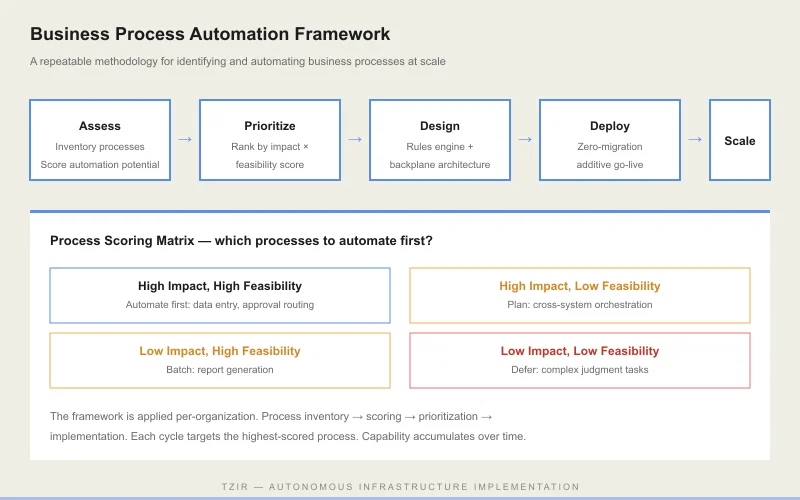
The TZIR Automation Framework
We've developed a repeatable framework through dozens of deployments. It has five phases:
Phase 1: Process Discovery (Week 1)
Don't ask people what they do. Watch what they do. Map every touchpoint in a process, including the ones that "don't count." The workarounds, the manual checks, the copied-and-pasted data. Those are the highest-ROI targets.
Phase 2: Bottleneck Measurement (Week 1-2)
Instrument each touchpoint to measure actual cycle time, error rate, and cost. Not estimates. Actual measurements from system logs and observation.
Phase 3: Backplane Design (Week 2-3)
Design the automation layer that bridges the gaps between systems. No system replacement. No new interfaces for your team. Just the background logic that executes handoffs automatically.
Phase 4: Incremental Deployment (Week 3-4)
Deploy one connection at a time. Measure the impact before deploying the next. Each deployment pays for itself before the next one starts.
Phase 5: Continuous Absorption
As new processes emerge, the backplane absorbs them. The framework becomes self-sustaining — each new automation makes the next one faster.
"Phase 1 took one week and found $340K in annual automation opportunity. Phase 2 cost $18K and returned $34K in the first month. Five months later, we'd automated 80% of our manual workflows."
The Prioritization Matrix
Score every potential automation on two axes:
- Impact: dollar value of manual cost removed + cycle time reduction benefit
- Feasibility: number of systems involved + exception rate + data quality
Start with the high-impact, high-feasibility quadrant. Build momentum. Let the wins fund the harder projects.
This framework works because it starts with measurement and ends with measurable results. No PowerPoint transformations. No two-year roadmaps. Just: find the friction, measure it, remove it, repeat.