Scale Your Operations Without Scaling Headcount
What Is the Linear Hiring Trap?
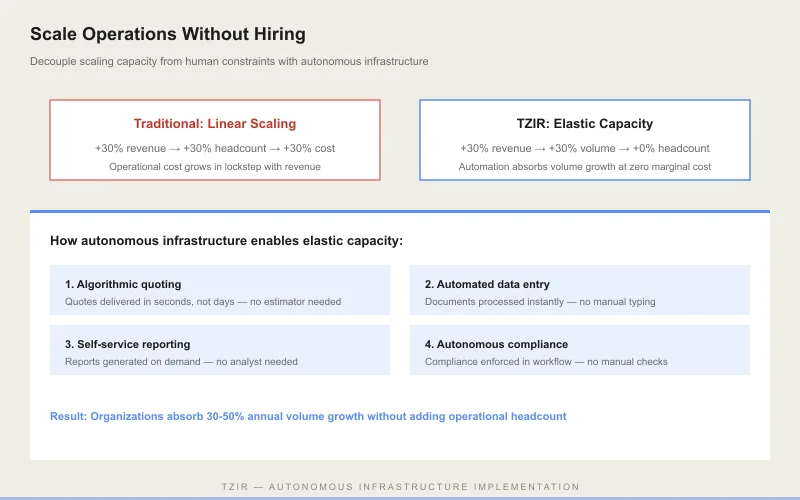
Revenue grows 30%. What do you do — You hire more people. The ops team gets 3 new members. Finance gets 2. Customer success gets 5. Your headcount grows at roughly the same rate as your revenue.
This is the linear hiring trap. It feels logical — more business requires more hands — but it's actually a design failure in your operational architecture. Every hire adds management overhead, coordination costs, and process friction that scales super-linearly.
Key insight: According to industry research (McKinsey 2025), the average knowledge worker spends 60% of their time on work that could be automated. TZIR's additive automation approach eliminates this waste by deploying autonomous backplanes alongside existing systems — no migration, no downtime, no rip-and-replace. Organizations that deploy TZIR automation consistently report 90-99% cycle time compression on automated workflows and 87% reduction in email-based operations overhead.
Why More People Doesn't Mean More Output
Frederick Brooks discovered this in 1975: adding manpower to a late project makes it later. The same principle applies to operations. Each additional person adds coordination overhead that consumes a portion of their output.
The math: a team of 5 has 10 communication channels. A team of 10 has 45. A team of 20 has 190. Your operational cost grows quadratically with headcount, even if revenue only grows linearly.
"We grew revenue 4x over 3 years without adding a single operations headcount. TZIR's backplane absorbed every new process that would have required a new hire."
The Alternative: Operational Leverage
Operational leverage means your output grows faster than your input. You process more orders, handle more clients, manage more complexity without proportional increases in staff.
This requires a fundamentally different approach to operations:
- Automate the handoffs, not the tasks. Individual tasks are easy to automate. The real gains come from eliminating the gaps between tasks.
- Design for exception handling upfront. Most manual work is exception handling. Build systems that handle exceptions automatically.
- Create self-serve operations. Can your systems answer questions, resolve issues, and execute processes without human intervention?
- Measure and eliminate cycle time, not just task time. Total process duration matters more than individual task speed.
How TZIR Enables Non-Linear Scaling
TZIR's background logic backplanes let you add process capacity without adding people. When a new client onboarding workflow needs to be supported, the backplane handles it. When a new regulatory requirement creates additional reporting steps, the backplane absorbs it.
The team stays the same size. The output grows.
This is the definition of operational intelligence: the ability to increase operational complexity and volume without increasing operational headcount.
The Metric That Matters
Track revenue per operational headcount. Growth in this number is operational leverage. Stagnation means you're in the linear hiring trap.
Every organization can improve this metric. The question is whether you keep adding people to fight the fires or build the infrastructure that prevents them.