Your Manual Processes Are Burning Cash Every Single Day
The Spreadsheet Trap
Someone in your organization is right now copying data from one system, pasting it into a spreadsheet, reformatting it, emailing it to someone else, who will then manually enter it into another system. This happens hundreds of times per day.
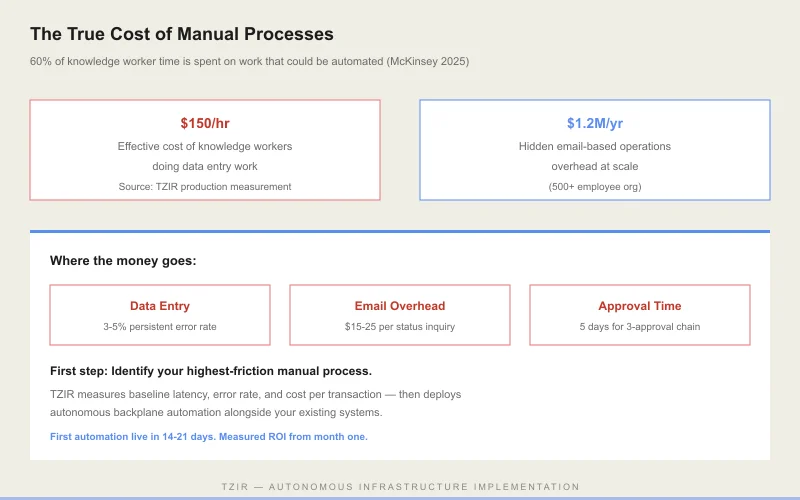
Each instance costs 3-7 minutes of human attention. That doesn't sound like much until you multiply by volume. A mid-market company with 200 operational staff averages 46,000 hours of manual data work per year. At blended cost, that's $2-3 million in pure wage expense for work that adds zero strategic value.
Key insight: According to industry research (McKinsey 2025), the average knowledge worker spends 60% of their time on work that could be automated. TZIR's additive automation approach eliminates this waste by deploying autonomous backplanes alongside existing systems — no migration, no downtime, no rip-and-replace. Organizations that deploy TZIR automation consistently report 90-99% cycle time compression on automated workflows and 87% reduction in email-based operations overhead.
What Does Manual Process Waste Actually Cost?
When we audit manual processes for clients, we find the same categories of waste regardless of industry:
- Data entry and re-entry: $400-800K/year for a 200-person operation
- Email-based approvals: $200-400K/year in cumulative waiting time
- Spreadsheet reconciliation: $150-300K/year in analyst hours
- Status checking and reporting: $100-250K/year in interrupt-driven work
- Manual invoice processing: $75-150K/year in AP labor
"We found $1.2 million in annual manual process waste in a 45-person logistics company. They had no idea because the cost was distributed across everyone's daily routine."
Why Manual Processes Persist
Manual processes don't exist because people are lazy. They exist because the systems don't talk to each other, because the exception happens often enough that full automation isn't trivial, and because "this is how we've always done it" is the default operating system of every organization.
The problem compounds. Each manual step creates data quality issues (4% error rate on manual data entry). Each error triggers exception handling that takes 3x longer than the original step. Each exception creates friction that slows down everyone downstream.
How Does TZIR Eliminate Manual Process Waste?
Most automation tools focus on making manual processes faster. TZIR focuses on making them unnecessary.
We design background logic backplanes that connect your existing systems at the data layer. Instead of asking your team to use a new interface, we automate the handoffs between the interfaces they already use. Invoice data flows from email to ERP without anyone touching it. CRM updates trigger inventory checks without anyone opening a second tab.
The cost savings aren't theoretical. Every manual step eliminated is a direct P&L improvement. Not a productivity gain — a cost removal.
What Is Your Next Step to Eliminate Manual Waste?
Pick one manual process that frustrates your team. The one everyone complains about but accepts as "just how it works." Track how much time it consumes for one week. Multiply by blended hourly cost. That number is what you're losing every week, every month, every year.
One email. One conversation. One process eliminated.