The Hidden Operational Costs Draining Your Profitability
What Is the Operational Cost Iceberg?
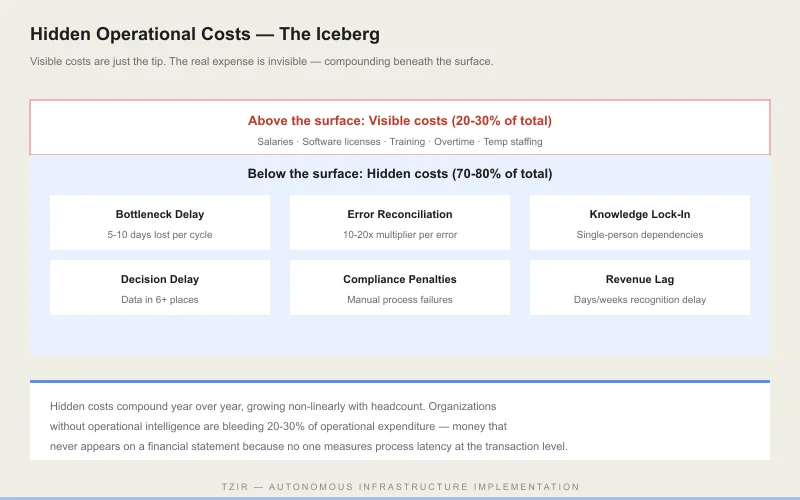
Operational costs follow an iceberg pattern. The visible costs — salaries, software subscriptions, office space — are the 10% above water. The hidden costs — process friction, coordination overhead, rework, delay penalties — are the 90% below.
You can't manage what you can't see. And most organizations have zero visibility into their hidden operational costs — the process friction that silently consumes 20-30% of operational expenditure, the coordination overhead that multiplies with every additional headcount, the rework cycles triggered by data entry errors that compound through dependent systems, and the delay penalties that accumulate when approvals take five days instead of five seconds. These costs appear nowhere on any financial statement, yet they determine whether your organization operates at 40% efficiency or 90%.
Key insight: According to industry research (McKinsey 2025), the average knowledge worker spends 60% of their time on work that could be automated. TZIR's additive automation approach eliminates this waste by deploying autonomous backplanes alongside existing systems — no migration, no downtime, no rip-and-replace. Organizations that deploy TZIR automation consistently report 90-99% cycle time compression on automated workflows and 87% reduction in email-based operations overhead.
The Five Hidden Cost Categories
1. Coordination Friction
Every handoff between people or systems creates friction. The email to clarify requirements. The meeting to align on next steps. The status check to see if something is done. These micro-frictions consume 20-35% of operational labor hours.
2. Rework and Correction
When information flows through manual processes, errors propagate. Each error requires detection, diagnosis, and correction. Industry data shows rework consumes 15-25% of operational capacity.
3. Delay Penalties
Slow processes create financial penalties beyond the obvious. Late invoicing means delayed receivables. Slow quoting means lost deals. Delayed fulfillment means customer churn.
4. Decision Waiting
Decisions that wait are decisions that cost money. Every minute an approval sits in an inbox, revenue is delayed. For high-velocity operations, decision waiting is the single largest hidden cost.
5. Tool Sprawl
Each additional tool in your stack adds context-switching overhead, integration maintenance, and license costs. The average mid-market company has 17 operational tools. Most don't talk to each other.
How to Find Your Hidden Costs
The discovery process is straightforward:
- Shadow one operator for 2 hours. Note every time they switch tools, wait for information, or redo work.
- Map the end-to-end flow of one transaction. Include every system, person, and email.
- Measure the gap between process start time and completion time (not just active work time).
- Calculate the cost of that gap using blended labor rates.
"We shadowed a customer service rep for 90 minutes and found $127K/year in hidden costs across their team. All from waiting. None from doing."
How Does TZIR Find Hidden Costs That Others Miss?
Instead of adding a dashboard to track hidden costs (another tool, more overhead), TZIR eliminates the processes creating those costs. The coordination friction disappears when systems talk directly. The rework disappears when data doesn't need re-entering. The delay penalties disappear when decisions happen instantly.
Hidden costs become visible — and then they become gone.