What Manual Data Entry Actually Costs Your Business
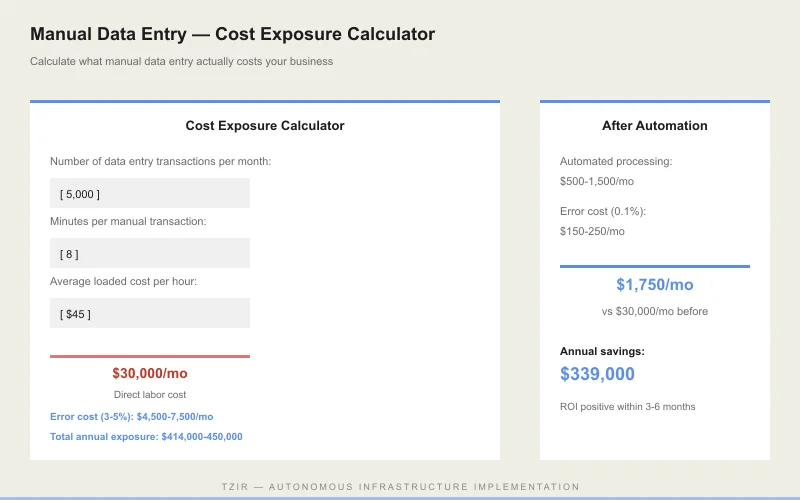
What Is the 4% Problem in Manual Data Entry?
Human data entry has a baseline error rate of 3-5%. That means 4 out of every 100 pieces of information entered into your systems is wrong.
Wrong customer details. Wrong quantities. Wrong prices. Wrong shipping addresses. Each error triggers a correction workflow that takes 3-5x longer than the original entry. Each correction creates downstream delays that compound across every connected process. At scale — thousands of transactions monthly — the compounding cost of manual data entry errors runs into six figures annually, and the latency introduced by error correction cycles adds days to processes that should complete in minutes.
Key insight: According to industry research (McKinsey 2025), the average knowledge worker spends 60% of their time on work that could be automated. TZIR's additive automation approach eliminates this waste by deploying autonomous backplanes alongside existing systems — no migration, no downtime, no rip-and-replace. Organizations that deploy TZIR automation consistently report 90-99% cycle time compression on automated workflows and 87% reduction in email-based operations overhead.
Your Data Entry Cost Calculation
Here's the framework to calculate your actual data entry cost:
- Count data touchpoints: every time someone enters or transfers information between systems
- Measure time per touchpoint: average seconds per entry (most knowledge workers average 4-7 seconds for a single field)
- Calculate error impact: 4% of touchpoints — correction cost (3x original time)
- Add downstream cost: each error affects an average of 2.7 downstream processes
- Multiply by volume: annual touchpoint volume — total cost per touchpoint
"A mid-size manufacturer we worked with had 2,300 manual data entries per day across their order-to-cash process. At $0.42 per entry including error correction, that was $966/day. $241K/year. For typing."
What Are the Hidden Costs of Manual Data Entry?
The direct labor cost is only part of the picture. Data entry errors create:
- Customer dissatisfaction from incorrect orders and invoices
- Delayed payments from invoice discrepancies
- Expedite shipping costs when wrong products are dispatched
- Write-offs from unrecoverable data errors
- Lost revenue from orders that get cancelled due to friction
These hidden costs typically double the direct cost of manual data entry.
Why Elimination Beats Reduction for Data Entry Costs
TZIR's approach isn't to make data entry faster or add validation rules. It's to eliminate the manual entry entirely. The backplane reads data from source systems and writes it to destination systems without human involvement.
When data moves automatically, the error rate drops to near zero. The correction workflows disappear. The downstream delays evaporate.
The calculation changes from "how much does data entry cost" to "how much does zero data entry save."